
Lipedema stages and types: what do they mean in practice?
The stages describe how the skin and tissue change: at stage 1 the skin is smooth, with more nodular tissue underneath; at stage 2, the skin develops dimples and the nodules get larger; at stage 3, the tissue becomes more fibrous, with large nodules and hanging lobules. Some classifications describe a stage 4, lipolymphedema, when lymphedema appears as a complication of the lipedema itself. The types describe where the buildup appears. Neither stage nor type measures pain, and the classification is made by a professional.
In short
- Stage is about the skin and tissue, not how intense the pain is
- Type is about where the buildup appears
- Someone at an early stage can have a lot of pain
- Classification is done in a physical exam, not from a photo
The stages
The stages look at the skin, the tissue just beneath it and the shape of the legs. In each drawing, on the left, the legs seen from behind; in the circle, the skin up close: the top line is the surface, and the lilac shapes are the nodular tissue underneath.
Stage 1
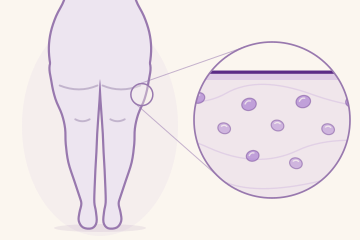
Smooth skin surface, with increased fat tissue that is more nodular underneath.
Stage 2
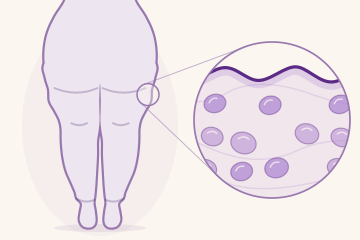
Dimpled skin, more tissue and larger, more numerous nodules that you can feel to the touch.
Stage 3
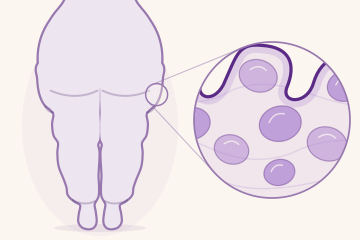
More tissue, more fibrous, with large nodules and lobules that hang over the skin.
Stage 4
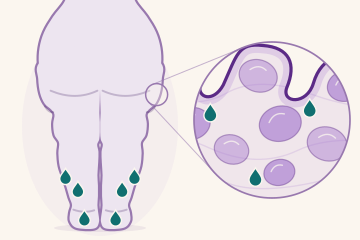
Used in some classifications: lipolymphedema, when lymphedema appears as a complication of the lipedema itself. Unlike lipedema, which usually spares the feet, lymphedema can affect them. The Brazilian Lipedema Consensus treats lipolymphedema as a stage only in this case.
The types
The types look at where the buildup appears. Highlighted, and with more volume, is the region described in each type.
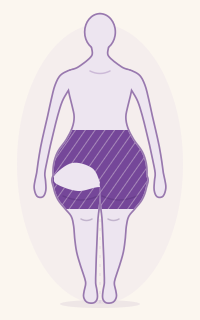
Type I
Below the navel, hips, buttocks and the upper thighs.
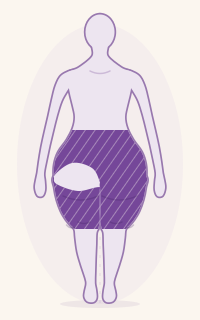
Type II
From below the navel down to the knees.
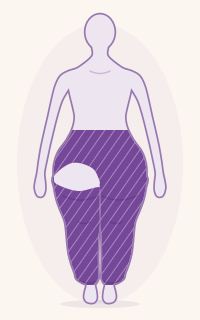
Type III
From below the navel down to the ankles.
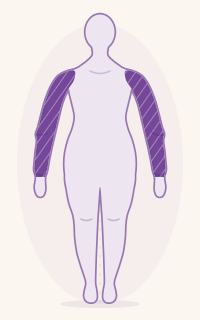
Type IV
Arms. Usually appears together with type II or III.
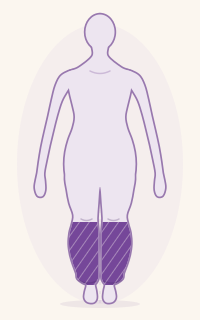
Type V
Only the lower legs.
What the classification does not tell you
Stage is not a measure of suffering. Some people at stage 1 have a lot of pain and some people at stage 3 have little. The classification helps describe the condition and plan care, but it does not sum up your experience.
That is why it is not worth trying to classify yourself from photos: the assessment depends on touch, on your history and on ruling out other conditions.
What we know and what we don't know yet
What we know
- The stages describe skin and tissue changes observed in a physical exam
- The types help describe how the buildup is distributed
What we don't know yet
- How, and in whom, lipedema progresses from one stage to another
- Why two people at the same stage can have such different levels of pain
When to seek professional care
- If you notice changes in texture or volume over the months
- If the swelling has started to affect your feet or hands
- If the pain has increased or has started to limit your mobility
Frequently asked questions
Is stage 3 more serious than stage 1?+−
It describes more skin and tissue changes, but not necessarily more pain. How serious it is for you also depends on your symptoms and how much they limit your daily life.
Can the stage go down?+−
Conservative treatment can relieve pain and swelling, but it does not remove lipedema tissue. According to the US guideline, only surgery removes this tissue, and it has its own indications and risks. Talk with your professional about what to expect in your case.
Sources
- Consenso Brasileiro de Lipedema · Jornal Vascular Brasileiro (opens in a new tab)
- Standard of care for lipedema in the United States · Herbst KL et al., Phlebology, 2021 (opens in a new tab)
- Lipedema: Pathogenesis, Diagnosis, and Treatment Options · Kruppa P et al., Deutsches Ärzteblatt International, 2020 (opens in a new tab)
- Diagnosing Lipedema · Lipedema Foundation (opens in a new tab)